
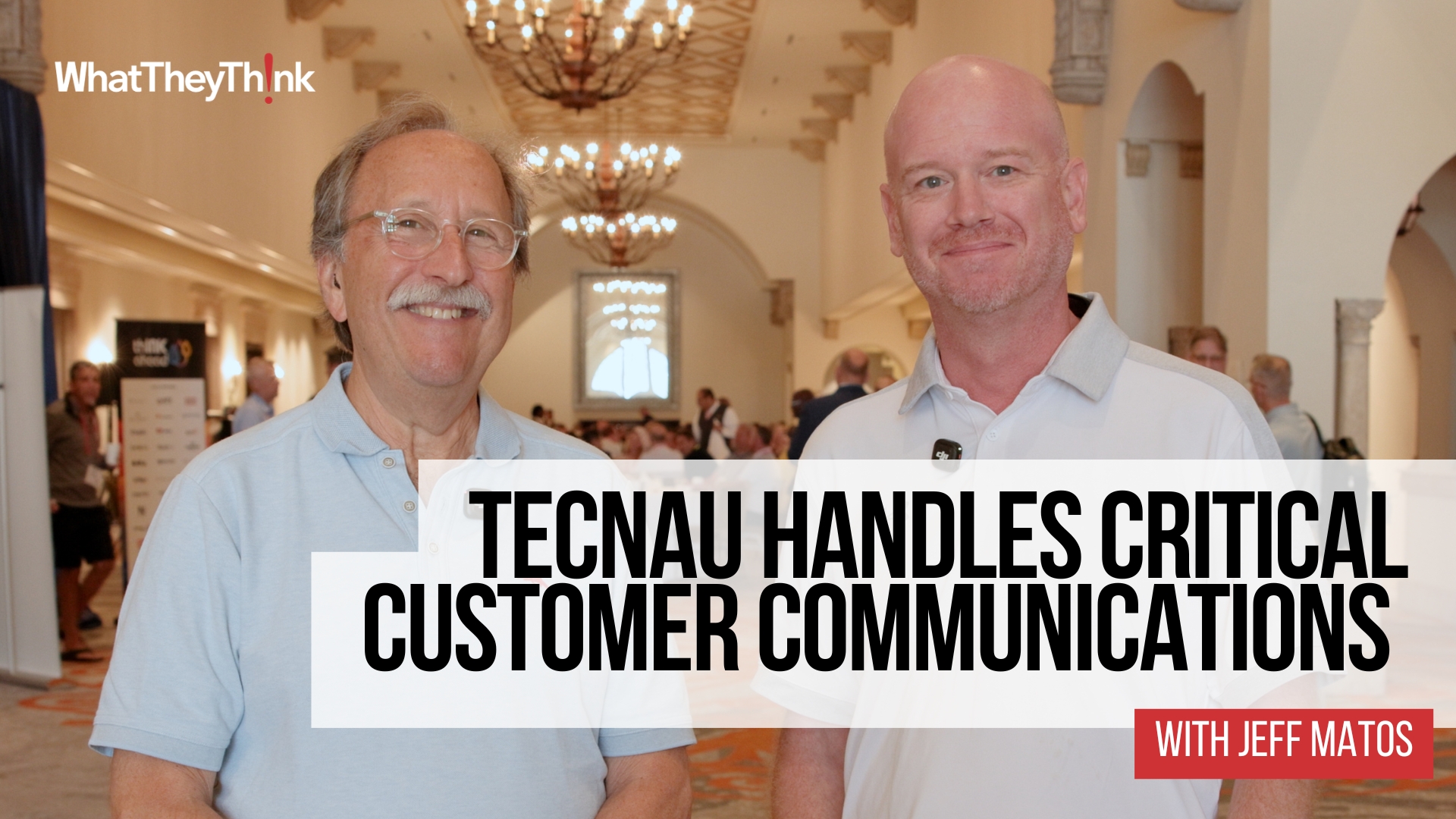
A conversation with Broadridge highlights the growing importance of connecting print, finishing, packaging, and fulfillment into a single efficient workflow.
The print industry is often measured by volumes, speeds, and productivity metrics. Yet for many of today's leading customer communication providers, true efficiency extends well beyond the printer itself.
In a recent WhatTheyThink interview sponsored by Tecnau | Sitma, industry analyst Dave Zwang spoke with Jeff Matos, Senior Director of Production at Broadridge, about the evolving needs of high-volume transactional print environments and the growing role of automation across the entire production chain.
As one of the world's leading providers of customer communications and technology-driven services for financial markets, wealth management, healthcare, telecom, utilities, and other highly regulated industries, Broadridge manages a complex mix of physical and digital communications. In such environments, workflow efficiency, production resilience, and operational flexibility are critical.
Automation Beyond the Press
During the conversation, Jeff highlighted the broad range of Tecnau solutions utilized within Broadridge's production ecosystem, supporting multiple output streams and finishing requirements.
From roll-to-roll and roll-to-cut workflows to dynamic perforation, punching, and roll-to-fold applications, Tecnau systems help Broadridge efficiently process output from continuous-feed inkjet platforms while maintaining the flexibility required to support diverse customer requirements.
The discussion reinforced a reality shared by many large print providers today: optimization can no longer focus solely on printing speed. The entire workflow must be considered, from data and document generation through finishing, packaging, and eventual delivery.
Learning Beyond Products
Earlier this year, Jeff joined a group of major North American print providers for an exclusive customer event hosted at the Tecnau and Sitma headquarters in Italy.
The objective of the event was to foster conversations around workflow automation, operational best practices, and future opportunities across print production and fulfillment.
Participants explored Tecnau's latest developments in digital print finishing while also gaining firsthand exposure to Sitma's packaging and logistics automation technologies.
As Jeff noted during the interview, the opportunity to meet with other customers, exchange experiences, and discuss different approaches to production challenges was equally valuable.
These conversations increasingly reflect a broader industry trend: organizations are looking beyond individual machines and focusing on how entire workflows can be optimized to reduce labor requirements, improve operational efficiency, and better manage peak production periods.
Closing the Final Gap
For many print service providers, significant progress has already been made in automating printing and finishing; the next frontier lies in what happens after the document leaves the finishing line.
Packaging, sorting, fulfillment, and logistics continue to present opportunities for improvement, particularly for organizations handling large volumes of customer communications and direct mail.
By bringing together Tecnau's expertise in digital print finishing and Sitma's capabilities in packaging and logistics automation, customers gain the opportunity to evaluate workflow improvements across the complete production process.
This integrated approach can help reduce manual touchpoints, accelerate throughput, improve consistency, and support faster time-to-market, especially during seasonal demand peaks where efficiency and labor availability become increasingly important.
Building the Future Through Collaboration
One of the strongest takeaways from both the customer event and the interview is the value of collaboration.
Whether through technology partnerships, customer feedback, or peer-to-peer discussions, innovation often emerges from the exchange of ideas and real-world experiences.
As organizations continue investing in digital production technologies, the focus is increasingly shifting toward connected workflows that span printing, finishing, packaging, and fulfillment.
The goal has shifted from producing more to producing smarter. From print, finish, package to profit.
Watch the Interview
Watch the complete conversation between Dave Zwang and Jeff Matos on WhatTheyThink to learn more about Broadridge's production environment, workflow strategies, and perspectives on the future of automation: