
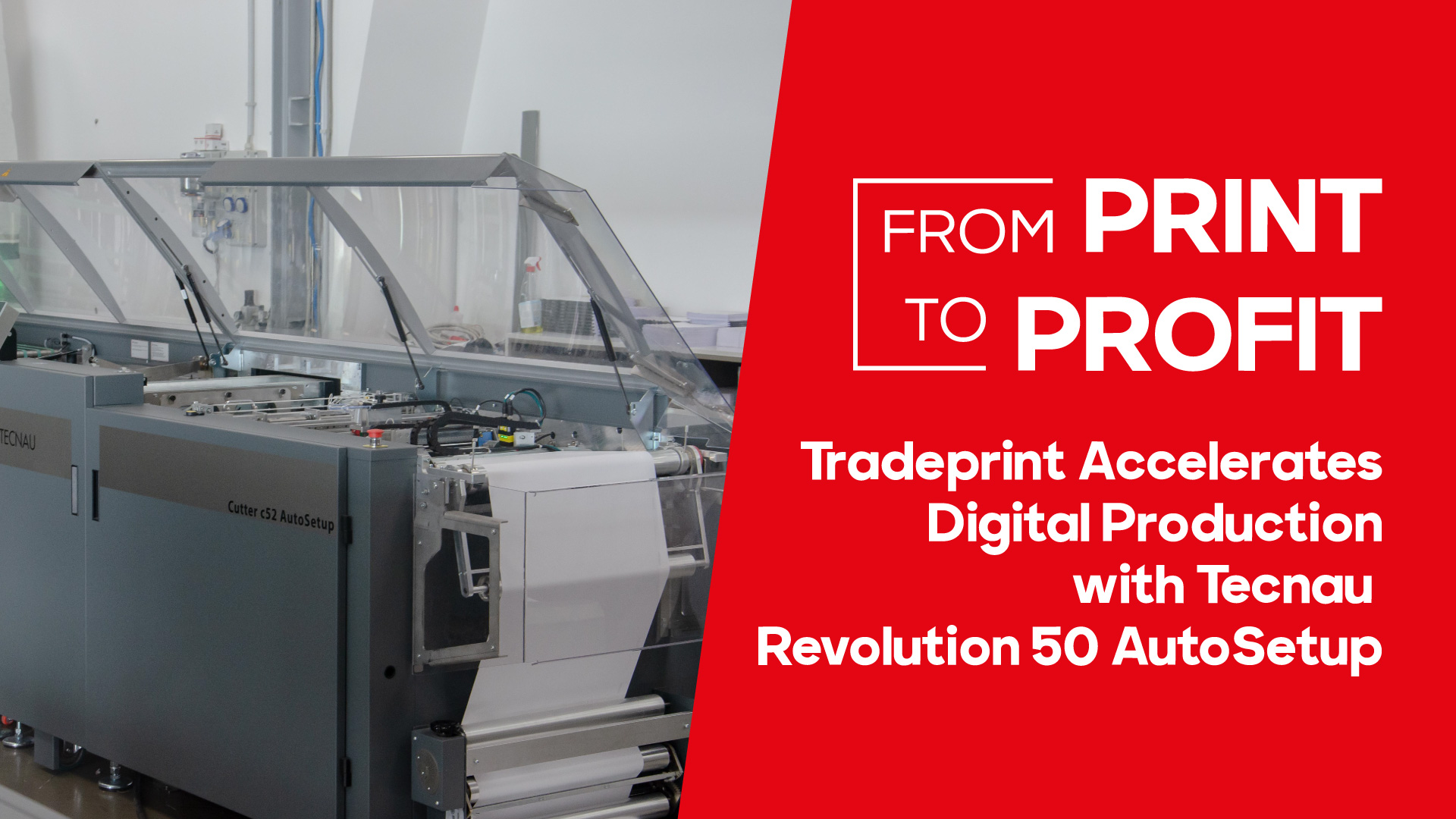
Tradeprint is taking another major step in the evolution of its digital production strategy with the investment in a Tecnau Revolution 50 Stack 5251L AutoSetup system, scheduled for installation this February. The solution will operate nearline with a Canon ProStream 3133, creating a highly automated digital print and finishing workflow designed for speed, flexibility, and scalability.
The investment forms part of a wider £3m programme aimed at increasing capacity and efficiency while supporting Tradeprint’s long-term focus on innovation and sustainability. Officially launched at drupa 2024, the Tecnau Revolution 50 AutoSetup has already been installed at several sites worldwide and has generated strong interest across the industry for its advanced automation, touchless job changeover, and ability to streamline complex digital finishing workflows.
Automation without Interruption
At the heart of the installation is the Revolution 50 AutoSetup’s ability to handle full-bleed applications with automated page length and imposition changeover. The system can switch seamlessly from one-up to four-up configurations without manual intervention, eliminating traditional touch points and setup delays.
This capability is particularly valuable for Tradeprint, which produces a broad mix of applications including bound books, wiro bound booklets, leaflets, and other marketing materials. Formats from A5 to A3 can be processed in sequence, allowing automatic switching between jobs without stopping production. The result is higher uptime, reduced waste, and consistent output even in highly variable production environments.
High-Speed Finishing for Variable Work
Supplied by Tecnau’s UK distributor Friedheim International, the fully automated finishing line runs at speeds of up to 180 m/min. It integrates trimming, cutting, and stacking in a single workflow and produces multi-up offset stacks.
Using 2D data matrix job recognition, the system automatically adjusts settings for different job types, ensuring accuracy and repeatability while minimizing operator involvement. This level of automation is a key enabler for handling high volumes of short-run and personalized print efficiently.
Intelligence beyond the Machine
The line is also equipped with Tecnau Connect, providing predictive maintenance and remote diagnostics. This connected intelligence allows performance data to be monitored in real time, supporting proactive maintenance strategies, faster troubleshooting, and improved overall equipment effectiveness.
For Tradeprint, this will mean greater production reliability and the ability to plan maintenance around real operational needs rather than fixed schedules.
Bridging Technologies, Not Replacing Them
Importantly, the new digital printing and finishing system is not intended to replace existing production lines. Instead, it bridges the gap between litho and SRA3 digital systems already installed, leveraging a web width of up to 23 inches for high-variable digital print applications. This approach will allow Tradeprint to route work to the most efficient technology, optimizing cost, quality, and turnaround across its entire production floor.
A Shared Vision for the Future of Print
Operations director Rod Scrimgeour explained that the investment reflects Tradeprint’s commitment to efficiency, innovation, and sustainability: “By adding the ProStream 3133 and Tecnau Revolution 50 line, we’re increasing our production speed, precision, and flexibility to meet growing customer demand, while continuing to invest responsibly in the future of print.”
From Tecnau’s perspective, the project represents a strong example of how advanced finishing automation can unlock the full potential of high-speed inkjet printing. Andrea Del Bianco, Area Manager for UK and Ireland at Tecnau, commented on the installation: “Tradeprint’s investment clearly demonstrates how automation and connectivity are becoming essential to modern digital production. The Revolution 50 AutoSetup will enable them to handle complex, variable work with maximum efficiency while maintaining the flexibility their business model demands.”